Patent Pending 63/970,430

Computation you can verify.
Every result traceable, every result trusted.

GDBS runs deterministic computation across many domains and binds every result to its source while reporting how much to trust it. A physics result is checked against the published value; a legal figure is computed against the controlling statute; a risk number is flagged where ordinary arithmetic would quietly lose precision. One engine, every answer auditable, running on the device in front of you - no install, and the work never leaves your machine.
A live compute API.
Run the engines over HTTP.

Authenticate, POST a function, and the job runs on your connected browser node - the real engine on your own GPU - returned when you poll for it. The compute stays on your device, not a rented server farm; the API routes the work and hands back the answer with its trust verdict. The same engines the app uses, now scriptable.

Every legal figure,
computed against the statute.

Garnishment caps, filing and statute-of-limitations deadlines, copyright and patent terms, overtime and ACA-affordability tests - computed deterministically and cited to the exact USC, CFR, or IRC section each figure came from. No black box, no per-check subscription, and the work never leaves your device. The same engine that validates a physics result computes a legally-defensible number.

LIGO's GW150914 final black-hole mass,
reproduced to 0.13% in the browser.

The final black-hole mass lands within 0.13% of the published value and the final spin within 0.65%, checked against Abbott et al. (LIGO/Virgo). The result is computed and compared, not fitted to the detection, and it runs on the device in front of you.

Double precision gives up at 171 factorial.
We keep going, and show our work.

IEEE 754 returns Infinity at 171 factorial and the computation stops there. GDBS stays in log space and returns log10(171!) = 309.0938, past the 308.2547 where a double runs out of exponent. Every step carries its accumulated drift forward, so each result tells you how much of it you can trust.

Anomalies a ledger hides,
flagged before the audit.

Screen a column of invoices or transactions against Benford's law - the first-digit distribution natural ledgers follow and edited ones break - with the chi-square statistic and conformity verdict computed deterministically and cited to Nigrini. It is a red flag for closer review, not a verdict of fraud, and it runs on the same engine that reproduces a gravitational-wave result, on your own device.

2.37e-4|div B| on a GPU
accretion torus
0.13%GW150914 final mass
vs LIGO (Abbott et al.)
0.0052%Hawking temperature
vs Hawking (1975)
AnyDevice: phone, laptop,
or workstation

Before & After

researcher@hpc-login On the cluster
GRMHD torus · rendered locally In GDBS

GDBS is the honest front end to the cluster, not a replacement for it. Do the validation work before you pay for the cluster.

gdbs.getvaultsync.com client-side / real-time / 0 ms queue

This is rendering on your device, right now - no upload, no cloud queue, no latency. The real engines run the same way: deterministic, drift-tracked, local. We compute the physics; we do not wait on a render farm.

The short version.

What it does

GDBS runs supercomputer-grade physics and math - numerical relativity, plasma physics, gravitational wave analysis, quantum circuit audit, 10 physics domains in total - in a browser tab. No install, no cluster, no cloud dependency, and the computation runs at zero marginal cost on hardware you already own. Every result is deterministic, reproducible, and auditable. Zero hallucination by architecture - there is no AI, no surrogate model, no training data.

Who it's for

Anyone who needs validated computational math but can't justify - or can't access - an HPC cluster. Researchers at underfunded institutions. Government analysts validating models before committing taxpayer dollars to cluster time. Defense engineers who need deterministic answers without cloud dependency. Enterprises in regulated industries - healthcare, legal, financial - who need auditable, drift-free computation that never leaves their device.

When to reach for it

When you're about to queue a job on a cluster just to verify math you could check locally. Every time a researcher burns allocation, budget, or a week of queue time to confirm correctness, that's the problem GDBS exists to eliminate. Validate the method in a browser tab in seconds, then take only the proven setup to HPC for the production run. Most domains GDBS serves - legal, compliance, finance, forensic - need no cluster at all.

Computers make tiny math mistakes. Yours never mentions it.

Every step of a calculation rounds off a little. One rounding is nothing. Millions of them add up, and the answer that comes out can be wrong, with nothing on the screen to warn you.

GDBS counts them. Every answer comes back with an honest note on how much to trust it. That is the whole idea.

Why it's fast

Being careful is slow, so GDBS is only careful where it needs to be. It is like driving: you don't crawl the whole trip, you go normal speed and slow down for the one bad curve. Most of any calculation is open road.

Why there's no waiting

Sending a problem to a supercomputer means getting in line, sometimes for days. GDBS answers while you are sitting there.

Where it runs

On your computer. Your numbers are never uploaded. Nothing to install.

Why it isn't AI

AI guesses what an answer probably looks like, and it can be confidently wrong. GDBS works the problem out and shows you where the answer came from. A science result points at the published paper. A legal number points at the actual law. Ask again next year, same answer.

Why a browser

Because it is the hardest place to pull this off, and the easiest place for you to use. Work that people assume needs a machine room runs on the laptop you already own, in a tab, right now.

Three steps. Compute, verify, trust.

Run it on your own device, get a result bound to its source with a verdict on whether to trust it, and act on an answer you can defend. For scientific work the proven setup then carries to HPC; most other domains need no cluster at all.

1 - Prototype

Open a browser tab and run real, validated computation on your own device. No install, no allocation grant, no job queue. Change a parameter and see the result - with its trust verdict - in seconds.

2 - Validate

Every result carries a transparent trust verdict, and where a published reference exists the error is measured against it, reproducibly, not tuned to it.

3 - Trust it, then scale it

Act on an answer you can defend - to a reviewer, an auditor, or a court - because it traces to its source and carries its verdict. For scientific work that needs production scale, the proven setup carries to HPC with the queue, allocation, and iteration cost already spent in the browser.

Measured against published references and reproducible in your browser: the GW150914 chirp mass to 0.41% and GW170817 to 0.27% against the LIGO catalogue values, and a Fishbone-Moncrief accretion torus confirmed as a general-relativistic equilibrium. Numerical relativity runs in-browser to a 256-cubed grid with the constraint residual and its drift reported alongside the result.

One engine, many domains. Every result, a verdict you can check.

GDBS runs deterministic computation across many domains in a browser tab - no install, no queue, and the work never leaves your device. Underneath, the GeoNum precision layer carries each result's drift and uncertainty forward, and every answer is bound to the source it came from, so you can tell exactly what to trust. For scientific work it is also the stage before HPC; for everything else it is the whole tool.

Drift-Tracked Precision

Floating-point error is accumulated and surfaced as first-class data, not hidden. Know exactly how much precision you have after every operation.

Multi-Physics Coupling

Chain MD → FEM → Fluids in automated feedback loops. Model turbine blade erosion, reactor degradation, hypersonic materials - problems that normally require dedicated clusters.

Batch Parameter Sweeps

Screen hundreds of alloy compositions or simulation parameters in parallel. Explore the full design space, not just a single data point.

HPC Lab Sandbox

Direct engine access for researchers who know exactly what they need. Run raw simulations, inspect intermediate states, export validated results.

Physics: 10 domains, each checked against published results.

Each domain ships with interactive tools and drift-tracked precision. Where a published reference exists, the result is checked against it and the error is reported, not tuned to it.

QuantumEnergy levels, H₂ ground state
FluidsCFD, boundary layers, compressible flow
PlasmaLandau damping, MHD
MaterialsElastic moduli, phase diagrams
GeophysicsSeismology, gravity, tectonic stress
BallisticsHypersonic aerodynamics, EM launch
TheoryHawking radiation, black-hole thermodynamics
MolecularMD simulation, surface erosion
Numerical RelativityBSSN + Z4c vacuum solver [addon]
Gravitational WavesLIGO strain conditioning, Welch PSD, Q-transform [addon]
See it run

Vacuum BSSN + Z4c on the GMDBS Toroid

A complete numerical-relativity solver compiled to WebAssembly: 4th-order finite differences, RK4 integration, Kreiss-Oliger 6th-order dissipation, 1+log slicing and gamma-driver shift, Z4c constraint damping. Built on the Apples-with-Apples gauge-wave initial data. The AwA testbed protocol itself (harmonic slicing at 50 to 200 points per wavelength over 1000 crossing times) is not run and no conformance to it is claimed. Citable, reproducible, written to be reviewed.

4th order against a known zero

The Hamiltonian and momentum constraints are exactly zero for vacuum data, so their measured residual is pure truncation error. Both converge at 4th order: 3.86 and 3.92 respectively, the momentum constraint falling 223x from N=16 to N=64. Measured against an answer the code did not produce. Choptuik factor-2 self-convergence under harmonic gauge separately reads 3.946, but self-convergence only proves the scheme is consistent with itself - it cannot detect converging to the wrong answer, and on this engine it once did.

Scaling: O(N³), exponent 3.048

Per-step wall-time scales as the volume, exactly as expected for an explicit grid solver. 23.94 µs/cell/step measured median. Pricing is licensing-only - no metered compute fees on top.

Bounded Long-Time Evolution

Pure BSSN holds for ~5 light crossings (literature-standard horizon for the canonical formulation-level mode). Z4c extension promotes the Hamiltonian and momentum constraints to dynamical fields with damping, extending stable evolution.

Citable Artifact

Validation document, reproducible test battery, and source provenance written for review. Research access: BSSN + Z4c free with a citation or testimonial (limited) - we want this work seen.

Scope, stated plainly: a browser-native NR testbed - for method development, convergence and stability validation, parameter studies, and teaching at single-GPU scale. Production mergers (AMR, matter coupling, multi-node) stay on HPC. GDBS bridges to that work by removing the queue, allocation, and iteration cost of getting there; it does not replace the cluster.

Read the validation results Z4c pathway document

Built for the people whose work has to be right.

If your answer has to hold up - to a reviewer, a regulator, an auditor, or a court - GDBS is where you compute it and prove it.

Scientists & engineers

Develop and validate a method on a laptop, checked against the literature, with a trust verdict on every value - then take a proven setup to the cluster only when you need production scale. Especially at institutions where cluster access is limited, queue times are long, or allocation budgets are tight.

Legal & compliance teams

Compute deadlines, garnishment caps, sanctions screens, and CMMC scores cited to the controlling statute or regulation - defensible, deterministic, and never leaving your device. No per-check subscription, no cloud dependency, and nothing on a server to subpoena.

Finance & forensic analysts

Risk and valuation math that flags the precision ordinary floating point hides, and ledger screening that surfaces anomalies before the audit - every figure reproducible and cited. Auditable to the digit - the computation runs on your device and the drift is reported, not hidden.

Educators & students

Teach and learn with real, validated computation that runs in any browser. No lab install, no cluster account, identical precision on every device.

See access tiers

GDBS and HPC do different jobs.

In the scientific domain, GDBS is the stage before the cluster, not a replacement - here is where each one fits. (Most other domains GDBS serves, from legal to finance, need no cluster at all.)

GDBS (browser) HPC cluster
Best forPrototyping, validation, teaching, parameter scansProduction-scale runs (AMR, matter coupling, multi-node)
To startOpen a browser tabRequest an allocation, wait in the queue
Iteration speedSeconds, on your own deviceHours to days per scheduled job
SetupNo install, no scheduler, no infrastructureMesh, modules, job scripts, scheduler
Trust per resultA trust verdict reported on every valueAssumed; checked separately
Scale ceilingSingle-GPU / browserEffectively unbounded
Cost modelLicense, no metered compute feesAllocation plus core-hours

The point is not that one beats the other. GDBS removes the queue, allocation, and iteration cost of getting a method right; the cluster runs it at production scale once it is.

Start Free. Scale to Research.

From exploratory tools to full research workflows.

Or build a la carte: pick only the modules you need, month to month, and run them as much as you want. No metered compute, no per-run fees - prepare an HPC run, or reach as far as you can without one.

STANDARD
Free

No credit card. Runs on your own hardware in the browser - no metered compute, no per-run fees.

  • GDBS database + Theoretical Foundations
  • Standard domains: materials, geophysics, fluids, quantum, topology
  • Unlimited runs
  • Optional Sandbox workspace add-on - $9.99/user/mo
  • Optional Worklog case-management add-on - $9.99/user/mo
  • Optional Gate client portal add-on - $9.99/user/mo
PRO
$29.99/user/mo

Everything in Standard, plus the professional domains and engines. Cancel anytime.

  • Plasma / fusion, medical / molecular, cosmology
  • Advanced multi-physics coupling + batch sweeps
  • Sandbox workspace + Worklog included
  • Unlimited runs
HPC
$39.99/user/mo

Everything in Pro, plus the HPC-class engines. Prepare an HPC run, or reach as far as you can without one.

  • HPC Lab + DFT engine
  • BSSN / Z4c numerical relativity
  • LIGO / NRSur gravitational waves + GRMHD accretion
  • Sandbox + Worklog Automation included

Validated against published results. Physics is one domain of many.

No AI. No surrogates. No tuning. No circular references. Real solvers running on your own hardware in the browser, every result carried with GeoNum drift-tracked precision and checked against a published or analytic reference - so you can trust it before you take it to the cluster.

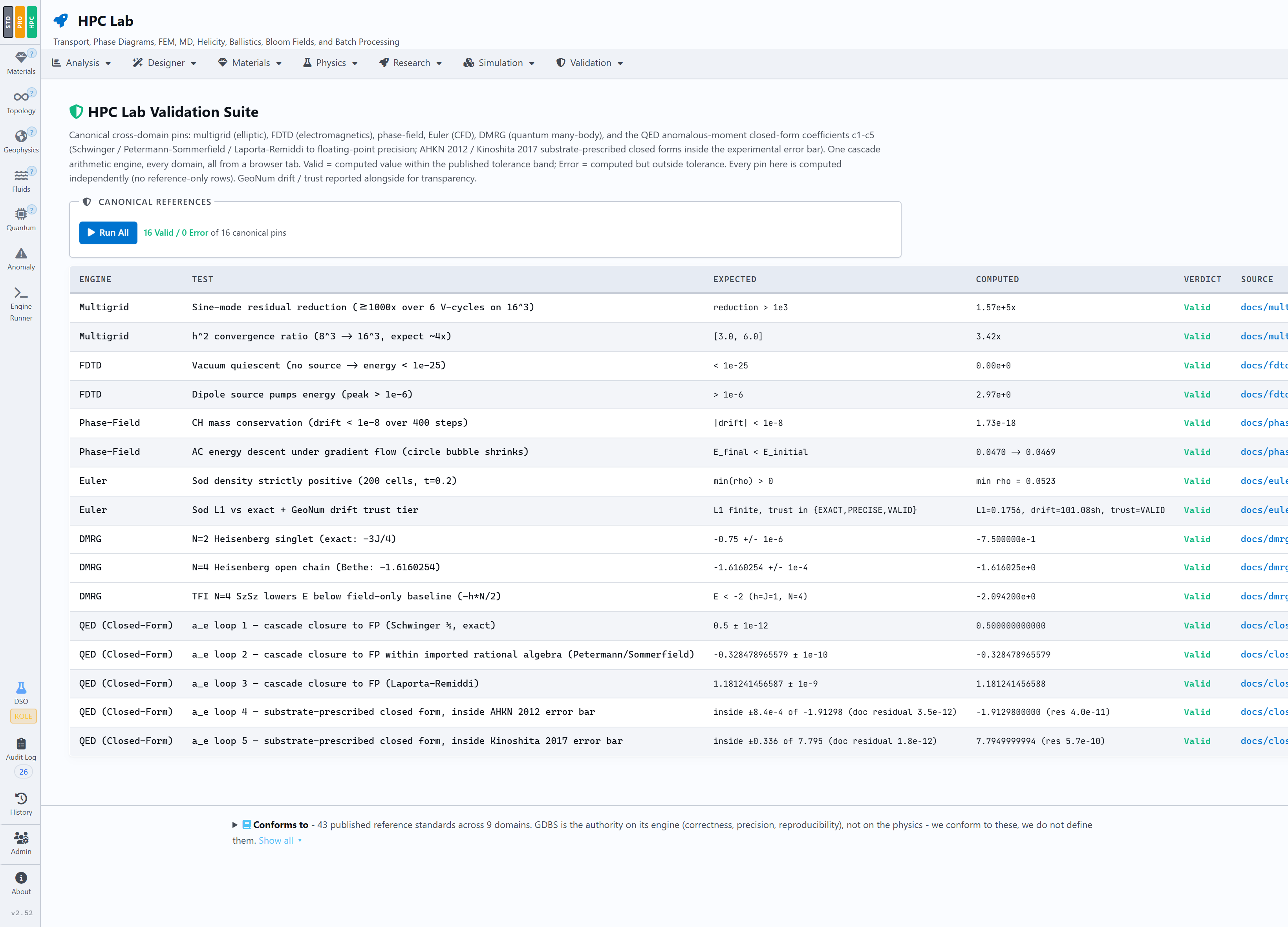
gdbs.getvaultsync.com / HPC Lab Validation Suite
GDBS HPC Lab Validation Suite - engine results checked against published and analytic references, every row VALID with a cited source

Every engine, checked against a published or analytic reference. Expected vs computed vs verdict, each row sourced. No tuning, no circular references - the engine computes it and the result is compared, live in your browser.

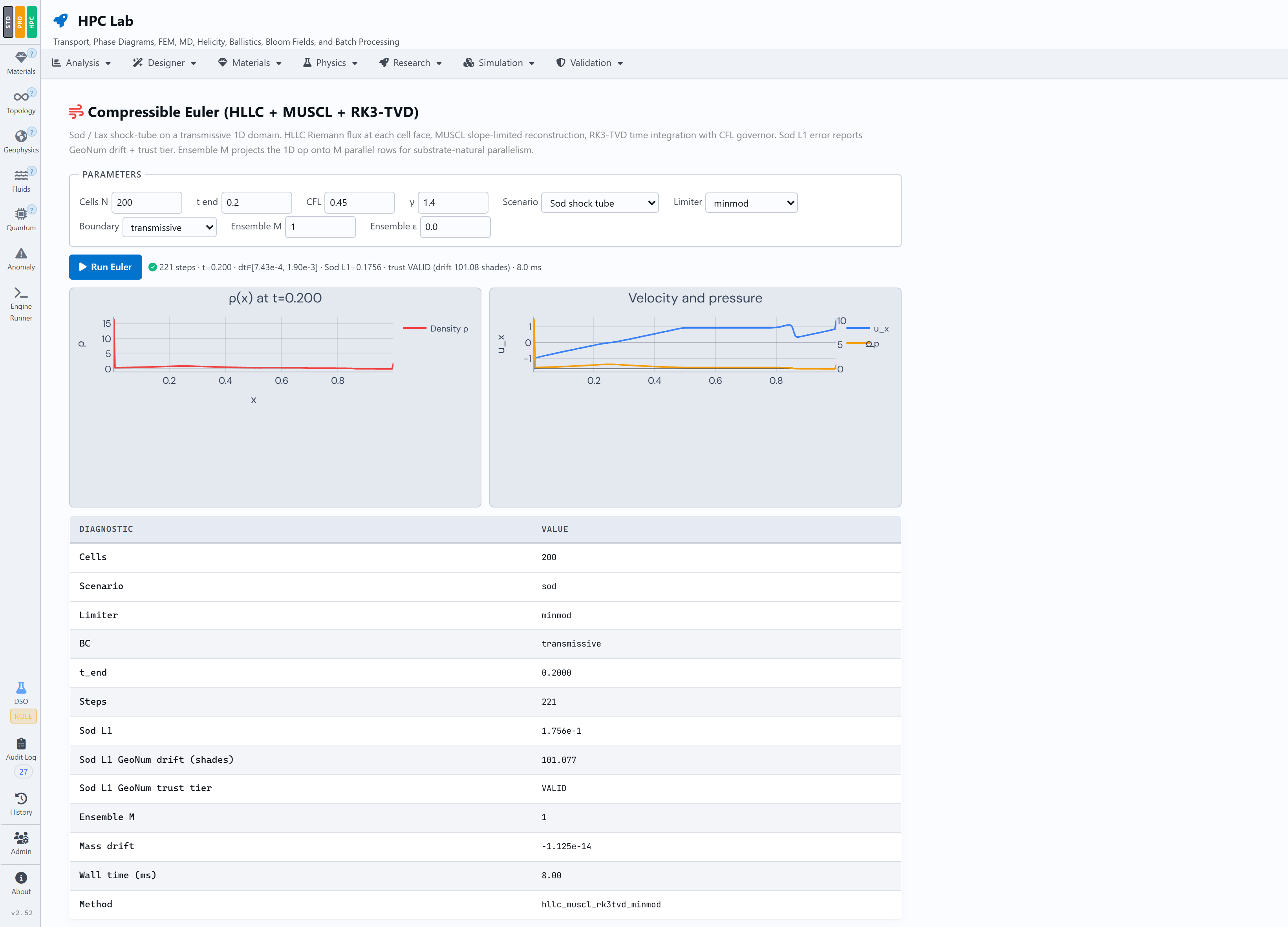
gdbs.getvaultsync.com / Compressible Euler
GDBS compressible Euler Sod shock tube - L1 error against the exact analytic Riemann solution, mass conserved, GeoNum trust VALID

Sod shock tube: L1 = 0.18 against the exact Riemann solution. Mass conserved to 1e-14, GeoNum drift tier VALID on every observable. A real HLLC+MUSCL+RK3 solver, measured against the analytic answer.

GDBS - Geometric Database

A native database engine built on geometric principles. Content-addressable seeds, 7D positioning, graph traversal, and a SQL-compatible query language. Free to use. No subscription required.

Seeds, Tiles & Hubs

Content-addressed records (seeds) organised into named collections (tiles) and auto-linked concept clusters (hubs). Proximity in 7D space encodes semantic similarity.

GQL - full CRUD

STORE, SELECT, NEARBY, LINK, TRAVERSE, CREATE TILE, UPDATE, DELETE. Standard SQL is translated automatically. REST + WebSocket server included.

Learning engine

Hebbian learning, STDP, and memory consolidation built in. Connections strengthen with use. Unused links decay. The database learns your access patterns.

GQL quick start
-- Store a seed (insert)
STORE 'Diamond: bulk modulus 442 GPa'
WITH type = 'elastic', material = 'Diamond'
IN materials  AS $diamond;

-- Geometric nearest-neighbour query
NEARBY 'bulk modulus cubic crystal' IN materials LIMIT 10

-- Graph traversal
TRAVERSE $diamond DEPTH 3

-- Standard SQL also works
SELECT * FROM materials WHERE metadata.material = 'Diamond'

Physics domain modules (plasma, materials, fluids, MD, quantum & more) run on top of GDBS and are available via the platform above.

Your computational data never leaves your device.

That's not a policy - it's the architecture. GDBS runs its physics and precision computation entirely in your browser via WebAssembly. Your inputs, parameters, and computed results are processed locally and are never transmitted to or stored on VaultSync servers. There is no server-side repository of your research data, so there is nothing to breach, subpoena, or leak. This is a stronger guarantee than most vendors can make, because they hold your data and promise to guard it; we simply never receive it.

What stays on your device

Computational inputs, parameters, and configurations. Computed results, charts, datasets, trust classifications, and downloadable bundles. All of it is generated client-side and saved to your local storage. VaultSync cannot access, recover, or produce your computational data, because we do not possess it.

API keys for third-party data sources (e.g. arXiv, Anthropic, your own services) are stored only in your browser's local storage and are never sent to VaultSync. They are read by the client at the moment of the outbound request and accompany only that request to its destination.

What we hold, and how we protect it

We store only account data - your name, email, institutional affiliation, subscription tier, and login timestamps - for license administration and authentication. That data is encrypted in transit (TLS/HTTPS) and at rest, hosted in the United States, and access is restricted to authorized personnel through role-based controls. Payment processing is handled entirely by Stripe under PCI-DSS compliance; we never receive or store card or bank details. The implementation details are below.

AreaImplementation
Client-side computeEngines run in-browser via WebAssembly; per the DUA, inputs and results stay local and are never sent to or stored on our servers.
Data at rest (account data)AES-256-GCM per write (random nonce + auth tag); every server-side collection encrypted; fail-loud decryption.
Data in transitTLS 1.2+ at the edge; HSTS; no cleartext fallback.
Password storageBCrypt hashed; constant-time verify with a dummy hash on unknown users to prevent enumeration.
Session authJWT (HS256), short-lived access + refresh tokens; refresh re-checks disabled accounts; reset tokens are single-use.
AuthorizationRBAC on all admin and investor endpoints; API keys capped to non-admin scope.
Path / injectionCharset-validated identifiers; paths confined to the data root; GQL identifiers and literals escaped; arXiv ids regex-validated.
Plugin / extension executionThird-party plugins run only in an isolated Web Worker under a worker-scoped CSP: no external module loading, no network egress, no DOM/GPU access, watchdog compute budget. Uploads are screened and sandbox dry-run, entering at unverified trust; violations auto-reject. First-party plugins are code-reviewed.
CORSExplicit allowlist (no AllowAnyOrigin); bearer tokens, no credentialed cookies.
Rate limitingPer-IP throttling on auth and anonymous endpoints against credential stuffing and abuse.
Request size limitsBounded request bodies on compute/substrate endpoints; usage-log fields capped.
Secrets managementNo secrets in tracked config; live values loaded at startup from an overlay outside version control.
License keys128-bit entropy; constant-time comparison.
Payment dataStripe Checkout redirect; cardholder data never touches GDBS (SAQ-A, PCI-DSS).
Audit loggingAll API calls logged with session id, action, and timing; admin activity has its own review surface.
HostingUS-based; TLS at the edge.

What we don't do

We do not sell, share, rent, or trade user data - ever, to anyone, for any purpose. No advertising. No data brokers. No third-party analytics beyond anonymized crash reporting. We do not use your data, inputs, or results to train any AI, machine-learning, or language model.

Server-side features, disclosed plainly

A few features - CORA retrieval, documented API endpoints, and the in-app support ticket - do send data to our servers to return a result. In those cases, data is used only to service the request and is not retained after the session ends, except active CORA session context during a live session. Everything else stays local.

On formal attestations

VaultSync does not currently hold a SOC 2 or equivalent third-party attestation. Because GDBS computation is client-side, the data surface a SOC 2 audit typically examines - customer data held on the vendor's systems - does not exist here. For organizations whose procurement requires a formal attestation, contact us at legal@getvaultsync.com to discuss your specific requirements.

Service & support

Support is available Monday-Friday, 9:00 AM-5:00 PM Central Time, excluding US federal holidays, via in-app ticket and email, with an initial response within one business day. Pro and HPC tiers get priority handling. Because computation runs locally, GDBS keeps working on your device even during a server-side service interruption.

TierSupport commitment
HPCPriority support per the EULA. Initial substantive response within 1 business day; priority handling.
ProInitial substantive response within 1 business day on a commercially reasonable basis.
Standard (Free)Best-effort handling via in-app ticket and email.

Documentation: EULA (PDF) · DUA (PDF) · Privacy. Additional documentation available under NDA - support@getvaultsync.com.

We Want to Hear From You

Feature requests, bug reports, research-access inquiries, research collaboration - our team responds to everything.

Frequently Asked Questions

Technical and product questions about GDBS, GeoNum, and how it compares to traditional HPC.

GDBS (Geometric Database System) is a browser-native verifiable-computation platform. One deterministic engine runs computation across many domains - physics checked against published references, legal and compliance figures computed against the controlling statute, forensic and financial math - and reports how much to trust every result instead of asking you to assume, with each answer traceable to the source it came from. For scientific work it is also where you validate a method before taking it to HPC; for most other domains there is no cluster at all, and GDBS is the whole tool.

For scientific work, it is not a replacement for the cluster - it is the step before it. HPC codes (VMEC, VASP, LAMMPS, Gaussian) run production-scale problems that need a mesh, an allocation, and a job queue. GDBS lets you develop and validate the same method first at browser and single-GPU scale: no allocation grant, no job scheduler, no specialized infrastructure, and a trust verdict on every result so you know the setup is right before you scale it. You iterate in seconds here, then take the validated method to HPC for the full run. For most other domains GDBS serves - legal, compliance, finance, forensic - there is no cluster at all, and GDBS is the whole tool.

No. GDBS is deterministic analytic geometry. There is no training data, no loss function, no gradient descent, no stochastic sampling, and no convergence criteria. The same inputs always produce the same outputs on every machine. It is not an approximation or a neural surrogate - it is an alternative computational representation of established physics.

GeoNum (Geometric Number Scale) is the precision arithmetic system underlying all GDBS computations. Standard IEEE 754 floating-point does not report how much precision a result has left. On a Hawking radiation calculation whose operands span 64 orders of magnitude (ℏ ≈ 10−34 to M ≈ 1030), GeoNum and IEEE 754 agree on the value; what GeoNum adds is a drift figure of zero, telling you the agreement is real rather than luck. Where IEEE 754 does fail outright, such as 171 factorial overflowing to Infinity or Muller's recurrence converging confidently to 100 when the true limit is 6, GeoNum either continues in log space or flags the result as unreliable before you act on it.

GeoNum shifts the precision challenge from bit-width to geometric structure. Four mechanisms work together:

  • Zone-tessellated addressing - values are encoded as field intensities within a geometric structure where zones identify the logarithmic scale region and shades provide discrete tessellation, maintaining consistent representation regardless of dimensionality d or node count n.
  • Logarithmic space arithmetic - by operating natively in logarithmic space, the system reconstructs precise values from zone and intensity rather than quantized bits. As n spans extreme dynamic ranges, drift accumulates only from the final quantization step - not from compounding intermediate rounding errors.
  • Domain-configurable zone boundaries - O(n1/d) scaling is handled by tuning zone boundary functions to match each domain's characteristic grid (uniform for CFD, spherical-harmonic-aligned for geophysics, lattice-symmetric for materials). Each axis of the d-dimensional precision grid carries n1/d resolution steps, achieving uniform precision density without exponential storage cost.
  • Transparent drift tracking - a drift compartment captures the fractional remainder of every arithmetic operation, so you can monitor exactly how much precision is retained as node resolution increases.

Hardware agnosticism: compute-intensive kernels are dispatched to WebGPU as a raw parallel substrate - but precision is not a hardware property. Whether the GPU is an integrated laptop chip, a mobile device, or a high-end workstation, the zone-tessellated structure and drift compartment produce the same value and the same reported drift. A researcher on a phone sees the same result, and the same statement of how much of it survived the arithmetic, as someone on a desktop. Precision lives in the geometry, not in the silicon.

Every physical system maps its parameters to coordinates in 13-dimensional position space, decomposed into four coherence tiers: Core (7D - fundamental observables), Magnitude (9D - energy scales), Phase (11D - oscillatory structure), and Proportion (13D - ratio relationships). Recursive relational layers up to 31D evaluate cross-tier coherence. Several physical outputs - βcrit, bulk modulus, gate fidelity, CMB multipole peaks - are read from the geometry of these coordinate relationships as a compact reduced-order representation. Where a problem genuinely needs a full PDE or SCF solve (DFT, numerical relativity, CFD), GDBS runs that solver too and reports its convergence and trust verdict.

Yes. The engine ships with re-runnable test suites that gate every release, and results are compared against a published reference where one exists. Representative results:

  • GW150914 final black-hole mass: 63.02 M against 63.1 (Abbott et al., LIGO/Virgo), 0.13%; final spin 0.6855 against 0.69, 0.65%
  • GW170817 chirp mass: 1.185 M against 1.188 (Abbott et al.), 0.3%
  • Quantum chemistry (H₂, H₂O, CH₄): Hartree-Fock energies within 0.5 to 2% of the STO-3G reference (Szabo and Ostlund)
  • Blasius flat-plate wall shear: 0.4696 against the canonical 0.4696, within 0.002 (Falkner and Skan, 1931)
  • Numerical-relativity constraint convergence against the analytic zero: Hamiltonian order 3.86, momentum order 3.92 (AwA gauge-wave initial data under harmonic slicing; the AwA testbed protocol is not run). Factor-2 self-convergence reads 3.946, reported as a consistency check rather than as validation
  • GPU constrained transport: magnetized accretion torus held |div B| to 2.37e-4 over the run, every observable carrying a trust verdict

Many domains, in two layers. The validated science layer spans seven physics areas, each with dedicated scan types and benchmarks against published references: Plasma & Fusion (tokamak/stellarator stability, MHD, FRC), Materials Science (elastic moduli, band gaps, phase transitions), Cosmology (galaxy rotation, CMB, dark matter), Geophysics (seismology, gravity anomalies, tectonic stress), Fluid Dynamics (boundary layers, drag, compressible flow), Quantum Information (error correction, qubit fidelity, entanglement), and Medical/Molecular (drug screening, protein stability, nanoparticle uptake). The professional layer adds deterministic, statute-cited tools for legal practice, regulatory and CMMC compliance, tax and forensic accounting, insurance claims, real-estate closings, HR and benefits, and RF metrology. Same engine, same trust verdict, every result traceable to its source.

GeoNum is not peer-reviewed. Precision results are validated against published HPC reference values and are fully reproducible by any user of the platform.

Yes. Results are deterministic and reproducible. Research users are required to cite GDBS in all published work, presentations, and reports. The GeoNum precision system is separately. When citing GDBS itself, use:

"Computational analysis performed using GDBS (Geometric Database System), developed by VaultSync Solutions Inc. https://gdbs.getvaultsync.com"

All physics computations run as WebAssembly in your browser - no server round-trips, no data sent unless you choose to save it. Results are only stored on GDBS servers if you explicitly use the Save Run feature. The platform includes a GQL query engine, database browser, CSV export, and a REST API for scripted workflows. If you don't save it, we don't keep it.

Sign In

Forgot password? No account? Create one